

Imagine spending months crafting the perfect content strategy, building high-quality backlinks, and fine-tuning your on-page elements, only to find your web pages hopelessly stuck on page two of Google. The culprit might not be your keywords or your content—it could be the very server your website lives on.
Choosing the right host becomes easier when you compare the leading options, so take a look at our complete review of the fastest web hosting providers for 2026.
Enter the world of seo server hosting, a specialized approach to web infrastructure designed to give your site a distinct competitive edge in search engine results.
Table of Contents
When evaluating web hosting services for small business or enterprise-level operations, many website owners simply look at the monthly price tag. However, treating web hosting as a mere commodity is a critical mistake. Search engines like Google prioritize user experience, and your server’s performance dictates exactly how that experience is delivered.
In this comprehensive guide, we will explore the tangible benefits of seo friendly web hosting, how server infrastructure directly impacts your search visibility, and actionable tips for choosing the ideal hosting environment to supercharge your organic traffic.

What Exactly is SEO Server Hosting?
At its core, seo server hosting isn’t a magical button that automatically ranks your website number one. Rather, it refers to a hosting environment meticulously optimized to meet and exceed the strict performance thresholds set by search engine algorithms.
Providers offering dedicated seo hosting services focus on speed, impeccable uptime, strategic geographic locations, and advanced security protocols. They provide an infrastructure that allows search engine bots to easily crawl and index your site while delivering a lightning-fast experience to human visitors. By investing in robust seo hosting solutions, you are essentially removing technical roadblocks that prevent your content from ranking to its full potential.
Why Your Web Host Matters for Search Engines
To understand why finding the best hosting for seo is so crucial, we need to break down the specific ways server performance interacts with search engine algorithms.
1. Speed, Core Web Vitals, and the Need for Fast Responses
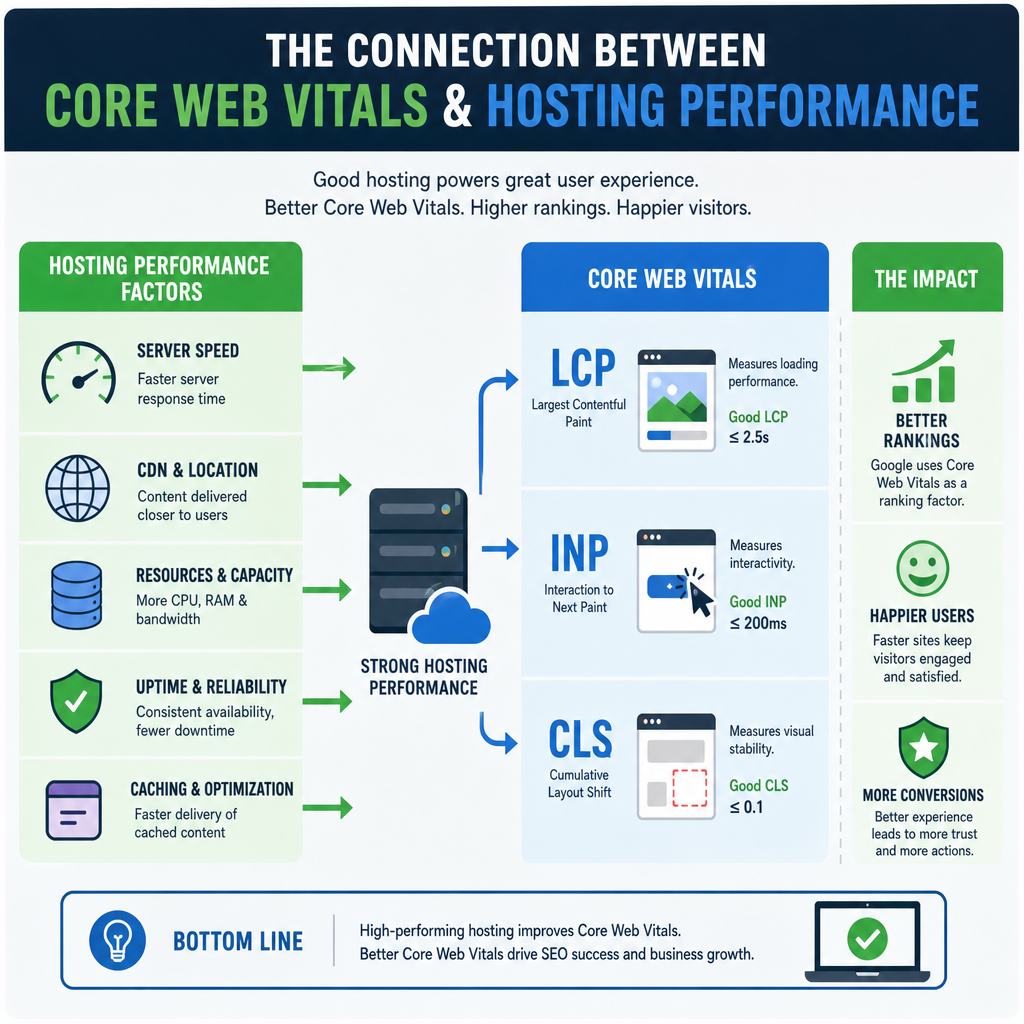
In recent years, Google has made it abundantly clear that page speed is a significant ranking factor. This was solidified with the introduction of Core Web Vitals, a set of metrics measuring loading performance, interactivity, and visual stability. The relationship between core web vitals and hosting performance is undeniable; if your server responds slowly, your Largest Contentful Paint (LCP) will suffer, dragging your rankings down with it.
A critical metric to monitor is Time to First Byte (TTFB). This measures the time it takes for a user’s browser to receive the first byte of data from your server. Wondering how to reduce time to first byte for better rankings? It starts with high-quality hosting. Premium hosts use advanced hardware (like NVMe SSDs), optimized databases, and lighter web servers to drastically cut down TTFB.
Furthermore, forward-thinking hosts are now implementing modern protocols. For instance, the use of the http3 and quic protocol for mobile search optimization is becoming a game-changer. These protocols reduce latency and ensure faster connections, particularly for mobile users on unstable cellular networks, which is vital given Google’s mobile-first indexing.
2. The Crucial Role of Uptime and Crawlability
Search engines rely on automated bots (spiders) to crawl the web. When Googlebot visits your site, it expects the door to be open.
So, how does server uptime influence crawler budget? Crawl budget is the number of pages a search engine will crawl on your site within a given timeframe. If a bot attempts to visit your site but the server is down, it receives an error. If this happens frequently, Google will lower your crawl budget to avoid overloading what it perceives as a fragile server. As a result, your new blog posts or product pages might take weeks to get indexed.
Fixing server downtime to prevent ranking loss should be a top priority. Moving to a reliable host that guarantees 99.99% uptime ensures that search engine bots can crawl your site freely, indexing your fresh content almost immediately.
3. Server Geography and Local Search Visibility
Where your server is physically located plays a surprisingly important role in SEO. The impact of server location on local SEO rankings comes down to latency and relevance. Data has to physically travel through cables; the further a user is from your server, the longer the page takes to load.
This is why choosing the best data center location for target audience proximity is a strategic SEO move. If your primary customer base is in Sydney, hosting your website on a server in New York introduces unnecessary latency. Instead, you should seek out the top web hosting australia has to offer to ensure data travels the shortest distance possible. While Content Delivery Networks (CDNs) help mitigate distance issues, having your origin server close to your primary audience provides a foundational speed advantage that search engines notice.
Shared vs. Premium: The Great Hosting Debate
A common question among webmasters is: does shared hosting affect search engine rankings?
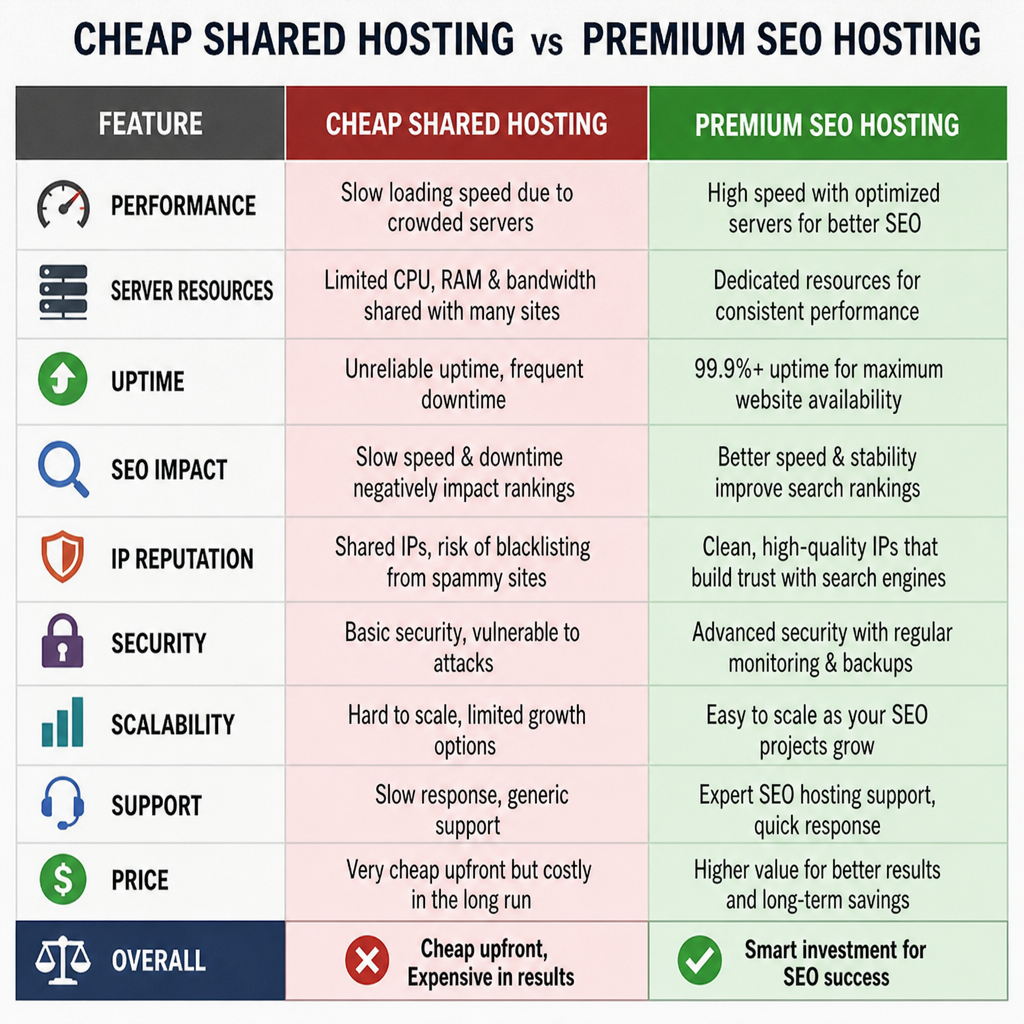
The short answer is: it depends on the quality of the shared host. However, when comparing cheap web hosts vs premium seo friendly providers, the risks of budget shared hosting become glaringly apparent.
On a cheap shared server, your website shares resources (CPU, RAM, bandwidth) with hundreds, sometimes thousands, of other websites. If another site on your server experiences a massive traffic spike or gets hacked, your site’s performance will plummet. This inconsistency directly harms your Core Web Vitals.
Additionally, shared hosting means sharing an IP address. While Google has stated that sharing an IP with a spammy site won’t inherently tank your rankings, there are still undeniable dedicated ip address for seo benefits. A dedicated IP ensures that your brand reputation is entirely in your own hands. It prevents IP blacklisting, ensures smoother email deliverability (which aids in outreach and marketing), and provides a cleaner technical setup for SSL certificates.
Actionable Tips for Choosing and Optimizing SEO Hosting
If you are ready to upgrade your infrastructure to support your SEO efforts, here are the key factors and technologies to look for:
Select the Right Architecture for Your Needs
Not all website architectures are created equal. You need to match your hosting type to your platform.
- For Bloggers and Service Businesses: Consider managed wordpress hosting vs unmanaged vps for speed. A managed WordPress host fine-tunes their servers specifically for WordPress architecture, offering built-in caching and security. An unmanaged VPS might be cheaper, but unless you are a Linux server expert, you will likely struggle to optimize it to the level of a managed SEO provider.
- For Enterprise and Retail: If you run a massive online store, you need high performance cloud hosting for large e-commerce sites. Cloud hosting offers auto-scaling, meaning that during high-traffic events (like Black Friday), your server resources automatically expand to maintain lightning-fast load times, preventing ranking drops caused by server crashes.
Implement Advanced Caching
Caching is the secret weapon of fast websites. Look for a host that offers robust server side caching techniques for faster indexing. Server-side caching (like Redis, Memcached, or Varnish) stores copies of your web pages directly on the server’s RAM. When a user (or a Googlebot) requests a page, the server delivers the cached version instantly without having to query the site’s database. This significantly lowers TTFB and speeds up bot crawling.
Demand Built-in Global Content Delivery
Even if you choose a data center close to your primary audience, you still want your site to load quickly for international visitors and search bots crawling from different global regions. Top-tier hosts offer free cdn integration for global website speed. A CDN (Content Delivery Network) stores static assets (images, CSS, JavaScript) on a network of servers worldwide, delivering them from the node closest to the user.
Never Ignore Security (SSL is Mandatory)
In 2014, Google officially announced that HTTPS is a ranking signal. Today, it is an absolute necessity. The ssl certificate impact on search visibility is profound; modern browsers will flag your site as “Not Secure” without one, causing bounce rates to skyrocket—a negative behavioral signal for SEO. Ensure your hosting provider offers free, auto-renewing SSL certificates (like Let’s Encrypt) and forces HTTPS at the server level.
Conclusion: Web Hosting is an SEO Investment
Treating your web hosting as a mere administrative expense is a missed opportunity. The foundation of a successful SEO campaign isn’t just great content and backlinks; it is the technical environment where that content lives.
By migrating to specialized seo server hosting, you directly improve your site’s speed, ensure search engines can effortlessly crawl your pages, and provide a flawless user experience that keeps visitors engaged. Whether it’s opting for a premium managed solution over a cheap shared host, leveraging server-side caching, or strategically choosing your data center location, every technical improvement you make is a step toward higher search engine rankings.
Don’t let subpar servers hold back your digital success. Invest in an infrastructure that works just as hard as your SEO strategy.
Ready to launch or upgrade your website? Visit Hostinger and compare its hosting plans to find the right option for your needs.
