


Creating an Effective SEO Roadmap Strategy
Imagine trying to navigate a cross-country road trip without a map, GPS, or even a basic sense of direction. You might eventually reach a destination, but you will waste an incredible amount of time, fuel, and energy getting there.
Search engine optimization operates on the exact same principle. Running random optimizations, publishing scattered blog posts, and hoping for the best is a recipe for stagnation. To drive meaningful, predictable traffic, you need a documented, dynamic seo roadmap strategy.
Table of Contents
Whether you are a startup founder doing self seo, an enterprise marketing director, or an enthusiast browsing global forums to belajar seo (learn SEO), success relies on structured execution. In this guide, we will explore how to create an seo strategy that cuts through the noise, aligns with your business objectives, and delivers sustainable organic growth.

What Exactly is an SEO Roadmap Strategy?
An seo roadmap strategy is a strategic blueprint that outlines the specific tasks, timelines, and resources required to improve a website’s organic search visibility. It transforms abstract goals into a concrete seo action plan.
Instead of treating SEO as a one-off project, an effective roadmap breaks the process down into phases—usually technical health, content creation, link authority, and ongoing measurement. Think of it as your ultimate seo strategy plan, designed to keep your team accountable and your efforts focused on high-impact deliverables.
Phase 1: Foundation and Technical Health
You cannot build a skyscraper on a cracked foundation. Before you write a single blog post or pitch a guest post, your website must be easily accessible to both search engine crawlers and human users.
Aligning Goals and Search Intent
The very first step in any successful campaign is understanding how to align business goals with search intent. If your company’s core objective is to generate enterprise software demos, driving thousands of visitors to a basic informational glossary won’t move the needle. Your roadmap must target transactional and commercial intent keywords that match your sales funnel.
The Technical SEO Audit
Next, you must assess the current state of your website. Utilize a comprehensive technical audit checklist for site health to identify critical errors. Key areas to inspect include:
- Indexability and Crawlability: Are search engines blocked by your robots.txt file or stray noindex tags?
- Site Structure: Focus on improving site architecture for better crawling. A flat architecture where any page can be reached within three clicks is ideal.
- Page Speed and Core Web Vitals: Ensure fast load times, visual stability, and quick interactivity.
- Mobile Responsiveness: With mobile-first indexing, a seamless mobile experience is non-negotiable.

Phase 2: Content Strategy and On-Page Optimization
Once your technical foundation is solid, it is time to focus on the core of your website: your content.
Research and Analysis
A robust content strategy relies heavily on competitive intelligence. It is vital to understand the nuances of content gap analysis versus competitor benchmarking. Benchmarking tells you how your domain authority, backlink profile, and overall traffic compare to competitors. A content gap analysis, however, identifies the specific high-value keywords and topics your competitors are ranking for that you are currently missing.
Use this data for strategic keyword mapping for topical authority. Instead of targeting isolated keywords, group them into thematic clusters. Create a highly detailed “pillar” page covering a broad topic, supported by multiple “cluster” pages addressing specific subtopics. This signals to search engines that you are a comprehensive authority in your niche.
Executing On-Page SEO
For those new to the field, strictly adhering to on-page optimization best practices for beginners is an absolute must. Ensure you:
- Place primary keywords in the H1, meta title, and URL.
- Use H2 and H3 tags to break up content logically.
- Optimize images with descriptive alt text.
- Include contextual internal links to keep users navigating through your site.
SEO Strategy Example: Let’s say you run a specialized B2B accounting firm. Your pillar page might be targeted at “Small Business Accounting Services.” Your cluster pages (linked back to the pillar) would cover “Payroll Tax Compliance,” “Virtual CFO Services,” and “Bookkeeping Best Practices.” This structure directly answers user intent while building immense topical relevance.
Phase 3: Authority Building and Off-Page SEO
Great content on a technically sound website will only get you so far. To dominate highly competitive search engine results pages (SERPs), search engines need to see external validation in the form of backlinks.
Scaling Your Outreach
Acquiring high-quality backlinks is notoriously difficult, which is why building a scalable link acquisition workflow is essential. This workflow should include:
- Prospecting: Using tools to find relevant, high-authority websites in your industry.
- Vetting: Ensuring the target sites have real traffic and are not spam farms.
- Outreach: Sending personalized, value-driven emails offering guest posts, broken link replacements, or digital PR assets.
- Relationship Management: Keeping track of communications via a CRM to nurture long-term editorial relationships.

Phase 4: Execution, Scaling, and Management
With a strategy in place, the challenge shifts to execution. How do you get all this work done efficiently?
Resource Allocation
If you are working within a large organization, managing resource allocation for enterprise SEO is a complex balancing act. You have to coordinate between web developers, content writers, UX designers, and PR teams.
At this stage, many companies debate the agency versus in-house search management benefits. An in-house team offers deep brand knowledge and immediate availability, but building one is expensive and time-consuming. An agency provides immediate access to specialized tools and veteran expertise, though it requires rigorous communication to ensure brand alignment. Choose the route that best fits your budget and growth trajectory.
Prioritization
Regardless of your team setup, you cannot do everything at once. Prioritizing organic search tasks for growth is the secret to early momentum. Use the ICE framework (Impact, Confidence, Ease) to score tasks. Fixing a broken checkout page (High Impact, High Ease) should always take precedence over rewriting 50 low-traffic blog posts (Low Impact, Low Ease).
Tracking Progress and Reporting
A roadmap is useless if you don’t track your journey. Because SEO is a long-term investment, managing expectations is a major part of the job.
Setting Milestones
When clients or executives ask how long to see search engine results, the honest answer is typically 3 to 6 months for initial traction, and up to a year for significant ROI. Because of this delay, measuring campaign success milestones—rather than just waiting for final revenue numbers—keeps teams motivated.
Early milestones might include fixing 100% of technical errors or publishing 20 new cluster pages. Mid-term milestones could be indexing speed and impressions growth. Long-term milestones are keyword rankings on page one and actual organic conversions.
Communicating with Stakeholders
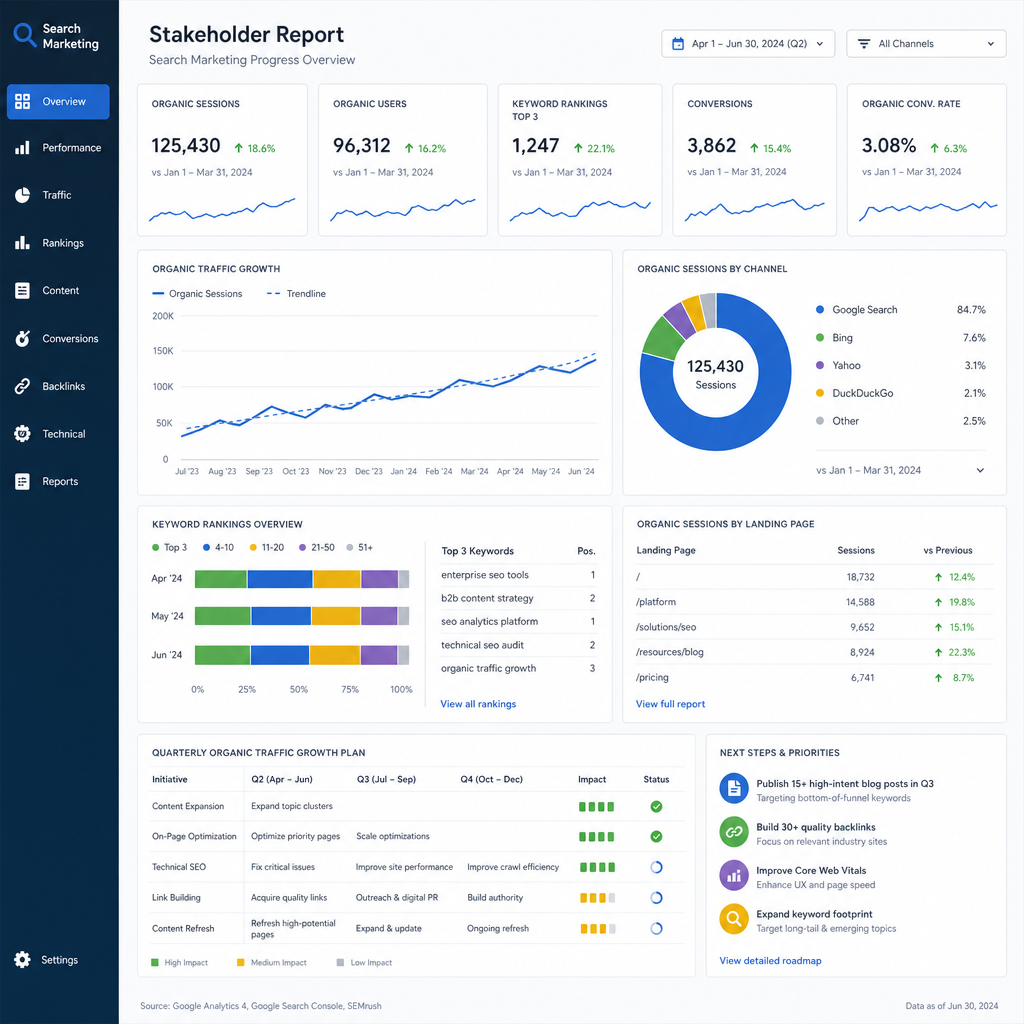
To maintain budget and executive buy-in, you must master stakeholder reporting for search marketing progress. Avoid overwhelming executives with jargon like “canonical tags” or “crawl budgets.” Instead, focus on quarterly organic traffic growth planning and tie your SEO metrics directly to revenue, lead generation, and customer acquisition costs. Show them how the roadmap is positively affecting the bottom line.
Summary: Your Step-by-Step Search Engine Optimization Framework
To recap, creating a winning roadmap requires moving systematically through a proven step-by-step search engine optimization framework:
- Audit and Align: Ensure your site is technically flawless and your keyword targets align with business revenue goals.
- Research and Map: Conduct a content gap analysis and build a content map designed for topical authority.
- Create and Optimize: Produce high-quality content following strict on-page optimization best practices.
- Build Authority: Implement a scalable, relationship-driven link-building workflow.
- Manage and Scale: Prioritize high-impact tasks and allocate resources wisely (whether in-house or via an agency).
- Measure and Report: Track specific success milestones and deliver business-focused reports to stakeholders.
Creating an effective SEO roadmap strategy is not a one-time event; it is an ongoing cycle of execution, analysis, and refinement. By moving away from random acts of marketing and committing to a structured, data-driven plan, you will build a sustainable organic growth engine that outlasts algorithm updates and outpaces your competition. Start drafting your roadmap today, and watch your search visibility transform over the coming year.
For the complete process, read our complete guide to Top 10 SEO tricks.