
If you work in digital marketing, content creation, or search engine optimization (SEO), you have undoubtedly encountered the name Ahrefs. It is universally recognized as one of the most powerful and widely used SEO platforms on the market. But despite its massive popularity, many daily users still find themselves asking: what does ahrefs stand for?
Unlike brands with obvious names, Ahrefs sounds like a technical acronym or a specialized code. And as it turns out, that is exactly what it is.
Table of Contents
In this article, we will dive deep into the fascinating geeky origins of the platform, provide a thorough ahrefs overview, and explore how a simple line of HTML code inspired a multi-million-dollar software empire. Whether you are an SEO veteran or a beginner setting up your first website, understanding the background of this platform will give you a greater appreciation for how search engines—and the tools that track them—actually work.

The Geeky Origin: What Does Ahrefs Stand For?
To truly understand the origin of the ahrefs brand name, we have to look away from marketing textbooks and dive directly into basic web development.
The name “Ahrefs” is derived directly from HTML (HyperText Markup Language), which is the standard coding language used to build and structure web pages. Specifically, it comes from the html anchor tag href attribute.
Let’s break down the anchor element syntax and usage. When a web developer wants to create a clickable link on a webpage, they use an “anchor” tag, represented by the letter <a>. However, an anchor tag alone does nothing unless you tell it where to go. That is where the href attribute comes into play.
A standard HTML link looks like this: <a href=”https://www.example.com”>Click Here</a>
In this code:
- a stands for “anchor,” signaling the start of a link.
- href stands for “hypertext reference.”
The purpose of hypertext reference in coding is to specify the destination URL of the link. It tells the user’s web browser—and search engine crawlers—exactly where they will be taken when they click.
Therefore, the literal ahrefs meaning is a tribute to the code that makes the World Wide Web interconnected. Links are the lifeblood of the internet, and since Ahrefs originally started strictly as a backlink analysis tool, the meaning of ahrefs company name is a brilliant nod to its core function: tracking HTML anchor tags across billions of webpages.
How to Pronounce Ahrefs Correctly
Because of its technical origin, many people struggle with how to pronounce ahrefs correctly. You will hear a variety of pronunciations in the marketing world, from “A-H-refs” to “Ah-refs.”
The generally accepted and official pronunciation used by the company’s own team is “A-H-refs” (pronounced: Ay-Aitch-Refs). This honors the distinct separation between the “a” tag and the “href” attribute in HTML code.
The Dmitry Gerasimenko Founder Story
To understand the history of ahrefs seo tool, we have to look at the man behind the code. The Dmitry Gerasimenko founder story is a classic tale of a programmer’s curiosity turning into a global enterprise.
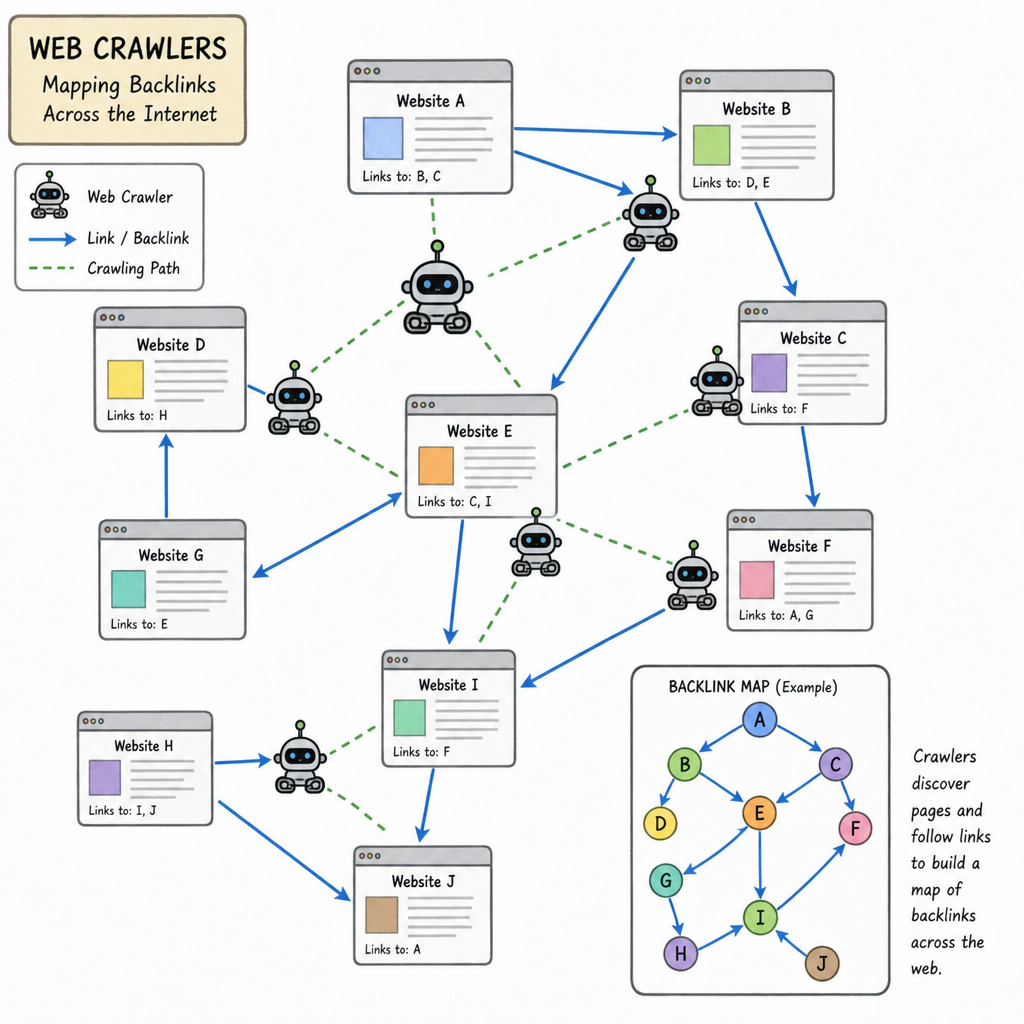
Dmitry Gerasimenko had a deep fascination with document retrieval and search engine algorithms. In the late 2000s, he began experimenting with web crawlers. He wanted to understand how web crawlers index backlinks—the process by which automated bots travel from one site to another by following those exact <a href> tags, mapping out the relationships between different websites.
In 2010, Dmitry successfully built a highly efficient web crawler. Realizing the massive value of the backlink data his crawler was collecting, he launched Ahrefs in 2011. Initially, it was a single-purpose tool designed to do one thing exceptionally well: map out the internet’s backlink profile faster and more accurately than any other software on the market.
Ahrefs Overview: From Link Checker to All-in-One Suite
If we were to define ahrefs in 2011, it would be strictly classified as a backlink checker. But if you look for an ahrefs definition today, you will find something entirely different.
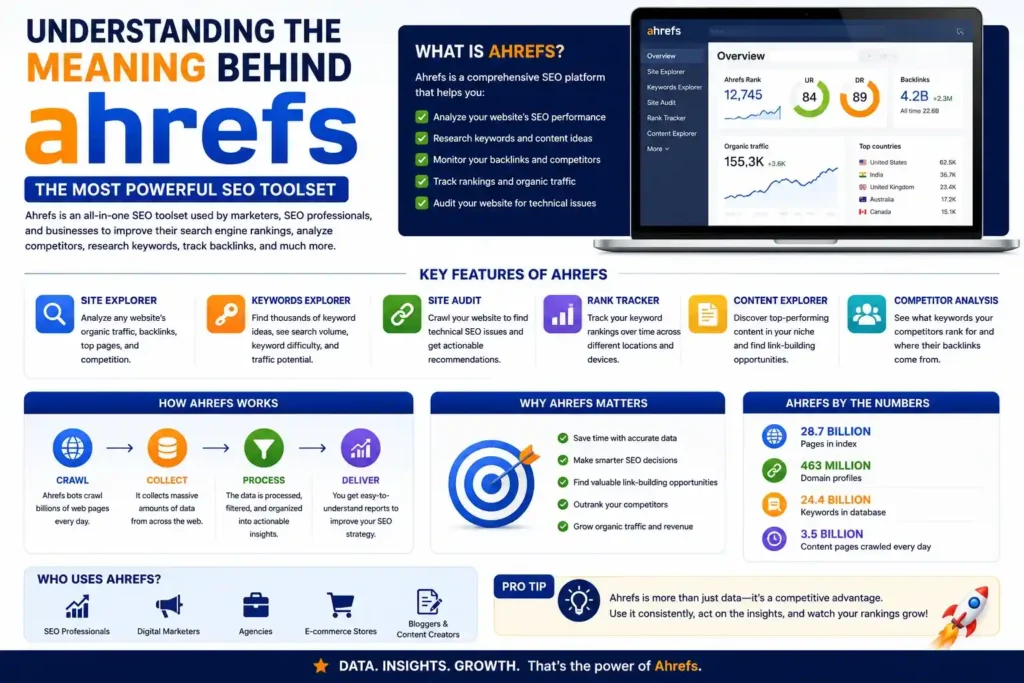
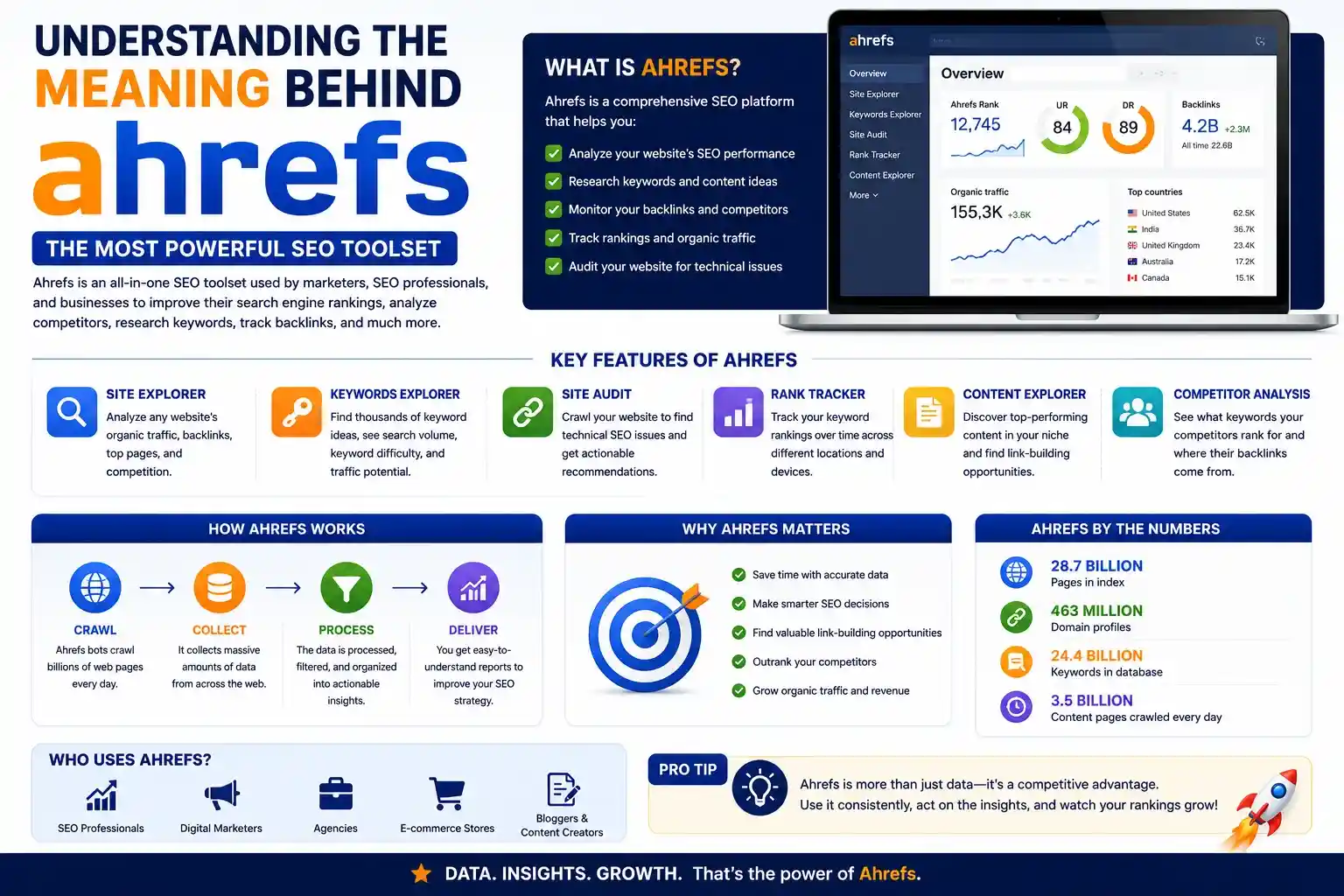
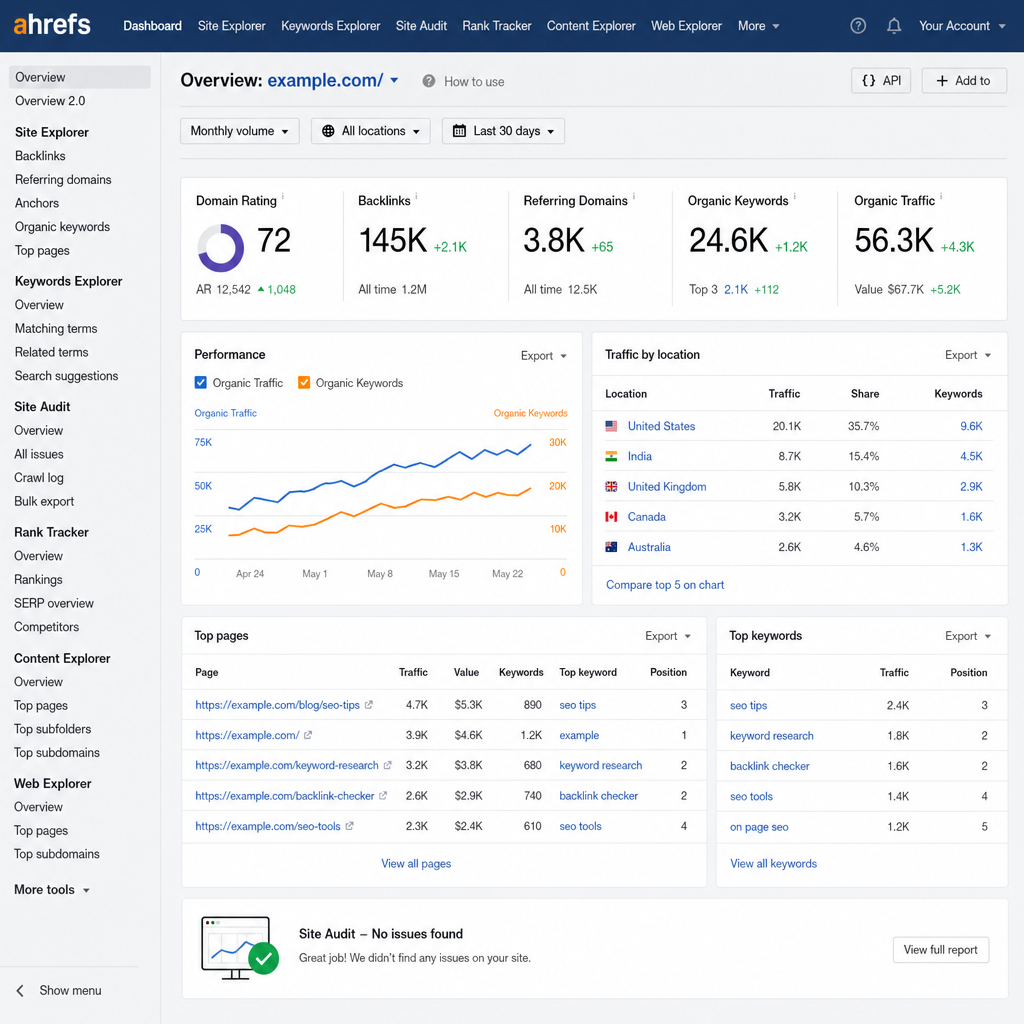
Today, Ahrefs is an all-in-one SEO software suite used to audit websites, research competitors, find keywords, and track ranking progress. This evolution is vital to understanding the modern platform. Let’s dive into a comprehensive seo toolset overview to see exactly what modern ahrefs tools and ahrefs features have to offer.
1. Site Explorer
Site Explorer is the crown jewel of Ahrefs. It allows you to enter any URL and instantly see its organic search traffic, paid search traffic, and backlink profile. This is where the platform’s world-class backlink analysis software features shine. You can see exactly who is linking to your competitors, what anchor text they are using, and the quality of the referring domains.
2. Keyword Explorer
Keyword Explorer operates on a massive database of search queries. It provides crucial metrics like Search Volume, Keyword Difficulty (KD), and Return Rate. It goes beyond Google, offering keyword data for YouTube, Amazon, Bing, Yahoo, and more.
3. Site Audit
Technical SEO is critical for website health. The Site Audit tool crawls your website much like Google does, flagging over 100 pre-defined SEO issues. It checks for broken <a href> tags, missing meta descriptions, slow page speeds, and redirect chains.
4. Content Explorer
Content Explorer is essentially a mini search engine built into Ahrefs. You can search for any topic and find the most popular articles based on social shares, organic traffic, and referring domains. This tool is heavily utilized by marketers putting together a building high quality backlinks guide, as it helps identify unlinked mentions and trending topics ripe for outreach.
5. Rank Tracker
Rank Tracker allows you to monitor your website’s ranking for specific keywords over time. It provides interactive graphs showing your progress, visibility score, and how you stack up against your direct competitors in both desktop and mobile search.
Decoding the Metrics: Domain Rating Versus Domain Authority
As you explore Ahrefs, you will frequently encounter the metric “DR,” which stands for Domain Rating. A common point of confusion for SEO beginners is the comparison of domain rating versus domain authority (DA).
While they serve similar purposes, they belong to different companies and use different calculation methods:
- Domain Rating (DR): This is a proprietary metric developed by Ahrefs. It measures the absolute strength of a website’s backlink profile on a logarithmic scale from 0 to 100. It focuses purely on link popularity (quantity and quality of external backlinks).
- Domain Authority (DA): This is a proprietary metric developed by Moz. It predicts how likely a website is to rank in search engine result pages (SERPs). DA calculates multiple factors, including linking root domains and total number of links, but also incorporates spam scores and other on-page factors.
Both metrics are highly useful for competitor analysis, but remember: neither DR nor DA are official Google ranking factors. They are strictly third-party estimations.
Ahrefs in the Competitive Landscape
When entering the world of digital marketing, users inevitably face a major decision regarding which software to invest in.
Ahrefs vs Semrush for Beginners
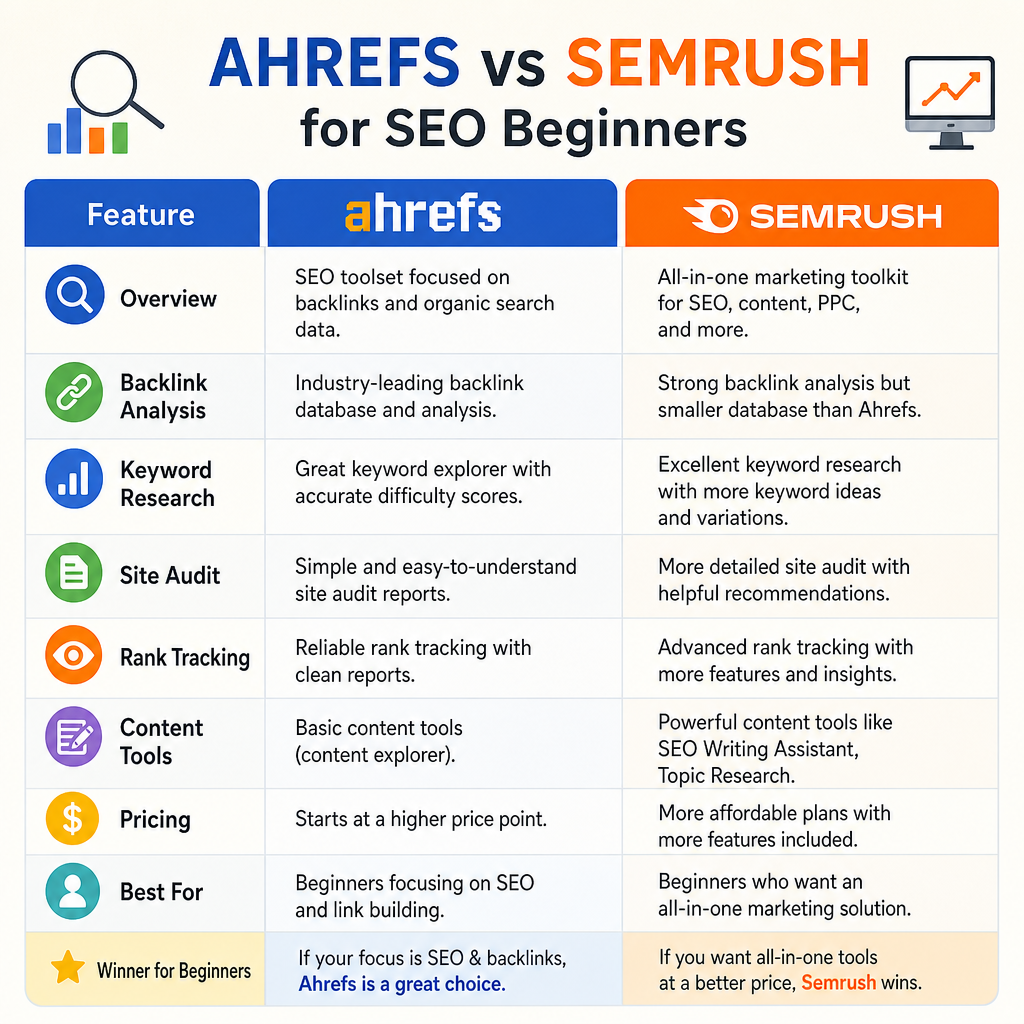
The debate of ahrefs vs semrush for beginners is one of the most common in the industry.
- Ahrefs is widely considered to have the most intuitive interface and the most robust backlink database. Its user experience is exceptionally clean, making it easier for beginners to digest complex link data.
- Semrush is often viewed as a broader digital marketing suite. While its SEO tools are phenomenal, it also includes deep features for PPC (Pay-Per-Click) advertising, social media management, and robust content marketing templates.
For beginners strictly focused on organic SEO, content ideation, and link building, Ahrefs is often the preferred choice. For those managing holistic marketing campaigns including paid ads and social media, Semrush provides a wider net.
Best Ahrefs Alternatives for Small Business
Because Ahrefs is an enterprise-grade tool, its pricing can be steep for solo entrepreneurs and startups. Fortunately, there are several best ahrefs alternatives for small business owners who need basic data without the premium price tag:
- Ubersuggest: Created by Neil Patel, this tool offers incredibly affordable keyword research and site audit capabilities.
- Mangools (KWFinder): Known for its gorgeous, beginner-friendly interface and highly accurate keyword difficulty scores.
- SE Ranking: A fantastic mid-tier option that provides comprehensive rank tracking, audits, and backlink checks at a more flexible price point.
- Google Search Console: It is free, directly from Google, and essential for every website owner, even if it lacks the competitive spying features of paid tools.
Actionable Tips for Maximizing Ahrefs
Now that you know what does ahrefs stand for and understand its capabilities, here are a few actionable tips to get the most out of the platform:
- Steal Competitor Keywords: Use the “Content Gap” feature. Input your domain and three of your top competitors. Ahrefs will show you exactly which keywords your competitors are ranking for that you are completely missing out on.
- Fix Broken Backlinks: Use Site Explorer to find “Broken Links” pointing to your site. Reach out to the referring domains and offer an updated URL, instantly reclaiming lost link equity.
- Find Low-Hanging Fruit: In Keyword Explorer, filter search queries by a Keyword Difficulty (KD) of under 15 and a search volume over 500. This will help you identify topics you can rank for quickly with minimal link building.
Conclusion
So, what does ahrefs stand for? It is far more than just a random collection of letters. It is a direct homage to the <a href> HTML tag—the fundamental building block of the internet that links one webpage to another.
From Dmitry Gerasimenko’s early days of building web crawlers to its current status as a dominant force in the SEO industry, Ahrefs has always stayed true to its core mission: mapping the web. By understanding the underlying mechanics of this powerful suite, you are better equipped to leverage its tools, outsmart your competitors, and climb to the top of the search engine results pages.
Read more : Understanding Site Architecture for SEO Success