Turn More Searches Into Customers
Get practical SEO strategies, ranking insights, and proven growth ideas delivered straight to your inbox—no fluff, just advice you can use.


If you have been working in search engine optimization for any length of time, you know the emotional rollercoaster of tracking keyword positions. One day you are celebrating a #1 ranking, and the next day, you are scratching your head because that top spot isn’t translating into actual website traffic.
This common scenario highlights a fundamental truth in modern SEO: rankings do not tell the whole story. To truly understand how your website performs on Google, you need to look beyond individual keyword positions and focus on your overall seo visibility score.
This vital metric takes the guesswork out of your performance analysis. By shifting your focus from isolated rankings to holistic search visibility, you can better understand your market share, analyze competitors, and make data-driven decisions that actually move the needle. Let’s dive deep into what an SEO visibility score is, how it works, and how you can use it to dominate your niche.

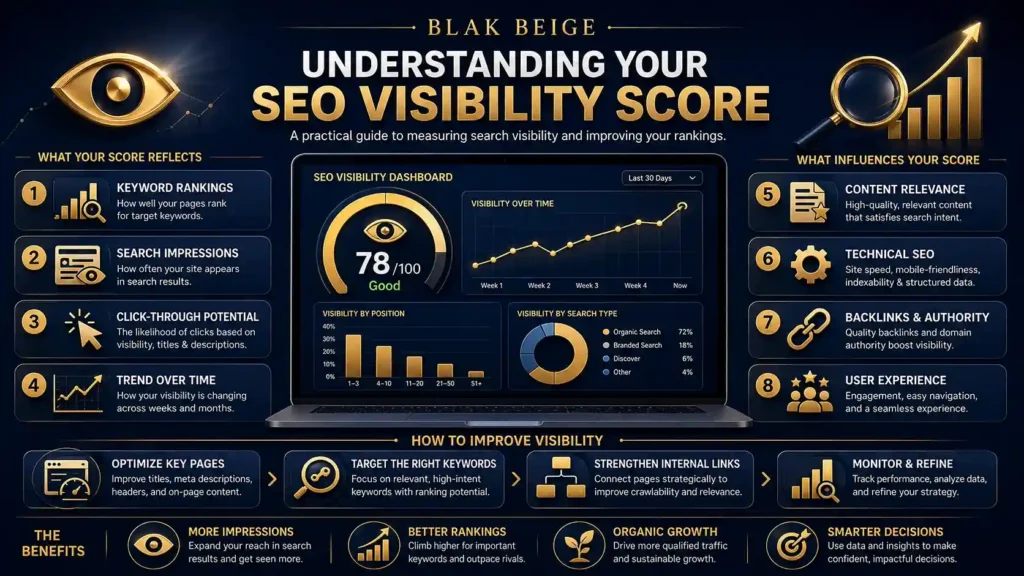
At its core, an seo visibility score is a metric that calculates the percentage of clicks your website is estimated to receive from its organic search rankings. You can think of it as your organic search share of voice.
When a user types a query into a search engine, the search engine displays a variety of results. Your search engine visibility dictates how prominent your website is across all those potential searches. If you have a score of 100%, it means you capture every single click for your tracked keywords (an impossible feat in reality). A score of 0% means you receive no clicks at all.
While different software tools might call it a google visibility score, a search visibility score, or simply search visibility, the foundational concept remains the same. It is an aggregated metric that gives you a bird’s-eye view of your website’s overall health in the search engine results pages (SERPs).
Understanding the math behind the metric can help you leverage it more effectively. So, how is search engine visibility calculated exactly?
While individual SEO platforms have their own proprietary formulas, most rely on seo visibility search metrics that combine three core variables:
To make this accurate, SEO platforms use weighted click-through rate models. A ranking at position #1 for a keyword with 10,000 monthly searches carries significantly more mathematical “weight” than a ranking at position #10 for a keyword with 100 monthly searches.
When comparing SEO platforms, it is important to note the nuances in their data. For instance, in the battle of Ahrefs vs Semrush visibility metrics, both tools provide excellent insights, but they calculate their scores slightly differently based on their unique keyword databases and CTR estimations. Semrush often displays “Visibility %” based on a specific campaign of tracked keywords, whereas Ahrefs might focus on “Traffic Value” or overall organic traffic share based on their massive global index.

Many marketers confuse keyword visibility with standard keyword rankings. However, understanding organic visibility vs keyword rankings is crucial for accurate reporting and strategy.
Rankings are absolute. You are either at position 3, or you are not. Visibility is relative and contextual. You could have fifty keywords ranking on page one, but if they all have a search volume of 10 searches per month, your overall visibility score will be incredibly low.
This concept becomes your best friend when diagnosing traffic loss despite stable rankings. Have you ever noticed your Google Analytics traffic dropping, even though your rank tracker shows no changes in your top keywords? This usually happens due to:
By tracking your visibility score rather than just rankings, you get a much clearer picture of your actual traffic potential.
To learn how to convert your social media followers into valuable website traffic, check out our insights on maximizing SEO through social media strategies.
Once you start tracking this metric, the immediate question is naturally: what is a good search visibility percentage?
The short answer is that there is no universal “good” percentage, because visibility is highly relative to the specific basket of keywords you are tracking and the competitiveness of your industry. However, here are some general benchmarks for a tracked keyword campaign:
Instead of chasing an arbitrary number, focus on your baseline. A “good” score is simply one that is steadily trending upward and outperforming your direct competitors.

You cannot discuss an seo visibility score today without addressing the rapid evolution of Google’s search results. Ten blue links are a thing of the past. Today, SERPs are crowded with videos, images, People Also Ask (PAA) boxes, local packs, and AI overviews.
The impact of SERP features on organic click share is staggering. A keyword might have 50,000 monthly searches, but if the SERP includes four top ads, a featured snippet, and a shopping carousel, the traditional #1 organic result might only receive a 5% click-through rate instead of the historical 30%. Your visibility score tools adjust for this by lowering the expected CTR when SERP features are present.
Furthermore, SEOs must account for the impact of zero-click searches on reach. If a user searches “what time is the Super Bowl,” Google answers the question directly on the results page. The user gets their answer and leaves without ever clicking a link. While ranking for these terms helps with measuring brand awareness in SERPs, it will not bring you direct traffic. A sophisticated visibility score will factor in these zero-click environments, preventing you from overestimating your traffic potential.

Understanding your score is only half the battle. The real value lies in taking action to improve it. Here are several proven ways to increase domain search presence and boost your overall visibility.
Since featured snippets (Position Zero) appear above traditional organic results, stealing them from competitors is a fast way to skyrocket your visibility. To do this:
Do not just look at your top 3 rankings. Tracking keyword rank distribution means analyzing how many keywords you have in positions 1-3, 4-10, 11-20, etc. A healthy website will have a “waterfall” distribution. If you notice a massive block of keywords stuck on page two (positions 11-20), those are your “low-hanging fruit.” A slight push through internal linking or content refreshing can bump them to page one, dramatically increasing your visibility score.
Your visibility does not exist in a vacuum. If your score drops, someone else’s score likely went up. Monitoring competitive landscape in search requires you to add your top three to five business rivals into your rank tracking tool. Watch their visibility curves. If a competitor suddenly spikes, audit their website. Did they launch a new content silo? Did they acquire a high-authority backlink? Reverse-engineer their success to win back your market share.
To maintain a high visibility score, you must proactively maintain your site. Here is how to audit search performance trends effectively:

Transitioning your focus from individual keyword rankings to an overarching seo visibility score is a hallmark of a mature, sophisticated SEO strategy. Rankings will always fluctuate daily, but your visibility score provides a reliable, stabilized view of your true market share and organic footprint.
To recap, keep these key points in mind:
By understanding and optimizing your search engine visibility, you equip yourself with the insights needed to capture more relevant traffic, outmaneuver competitors, and ultimately drive meaningful growth for your business. Start tracking your visibility score today, and watch your SEO strategy transform from reactive to remarkably proactive.