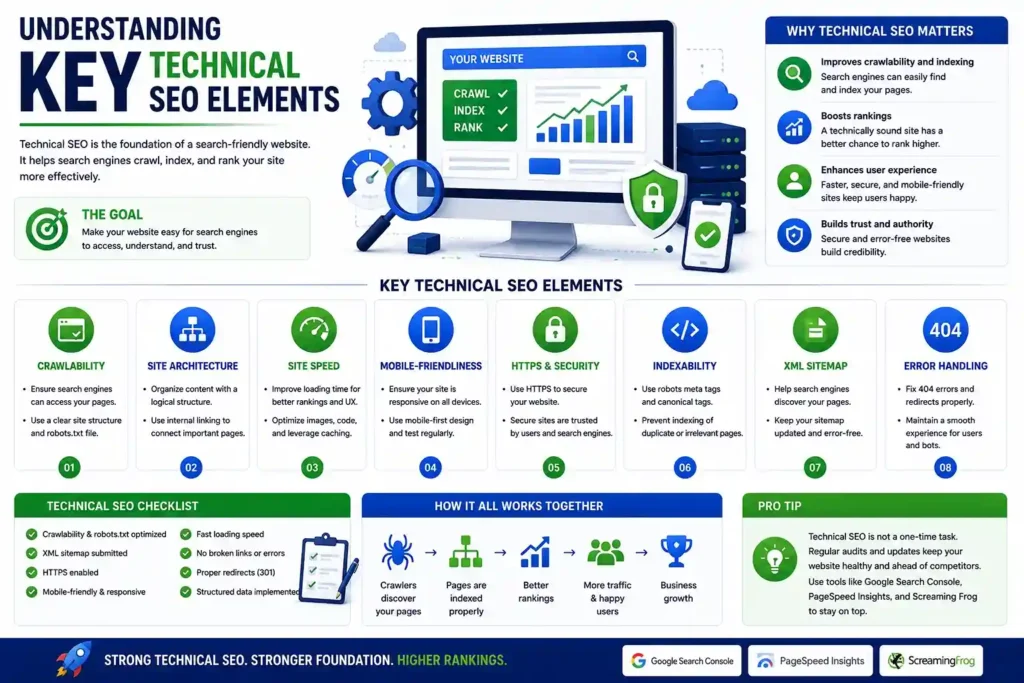

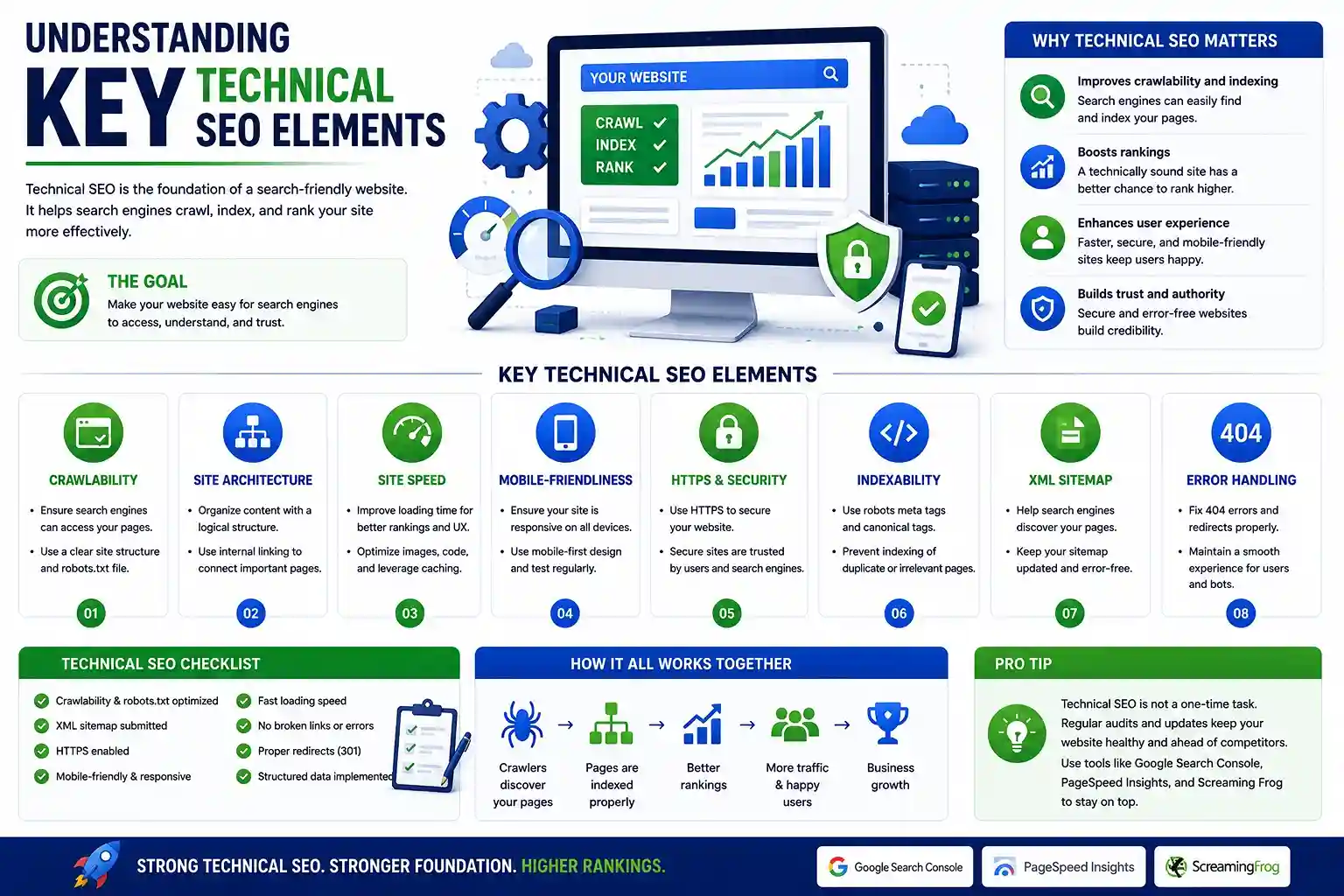
Imagine spending months building a magnificent, state-of-the-art store, only to realize you forgot to build roads leading to the front door. No matter how incredible your products are, no one can get inside to buy them. In the digital world, this is exactly what happens when you have a beautifully designed website but ignore your underlying technical foundation.
While excellent content and traditional on-page SEO tell search engines what your website is about, technical SEO elements ensure that search engines can actually access, read, and index that content. Without a solid technical backbone, your highest-quality articles and product pages will remain invisible to Google.
Table of Contents
In this comprehensive guide, we will break down the essential components of technical SEO. Whether you are a small business owner or an enterprise marketer, understanding these concepts will help you build a website that search engines—and users—absolutely love.
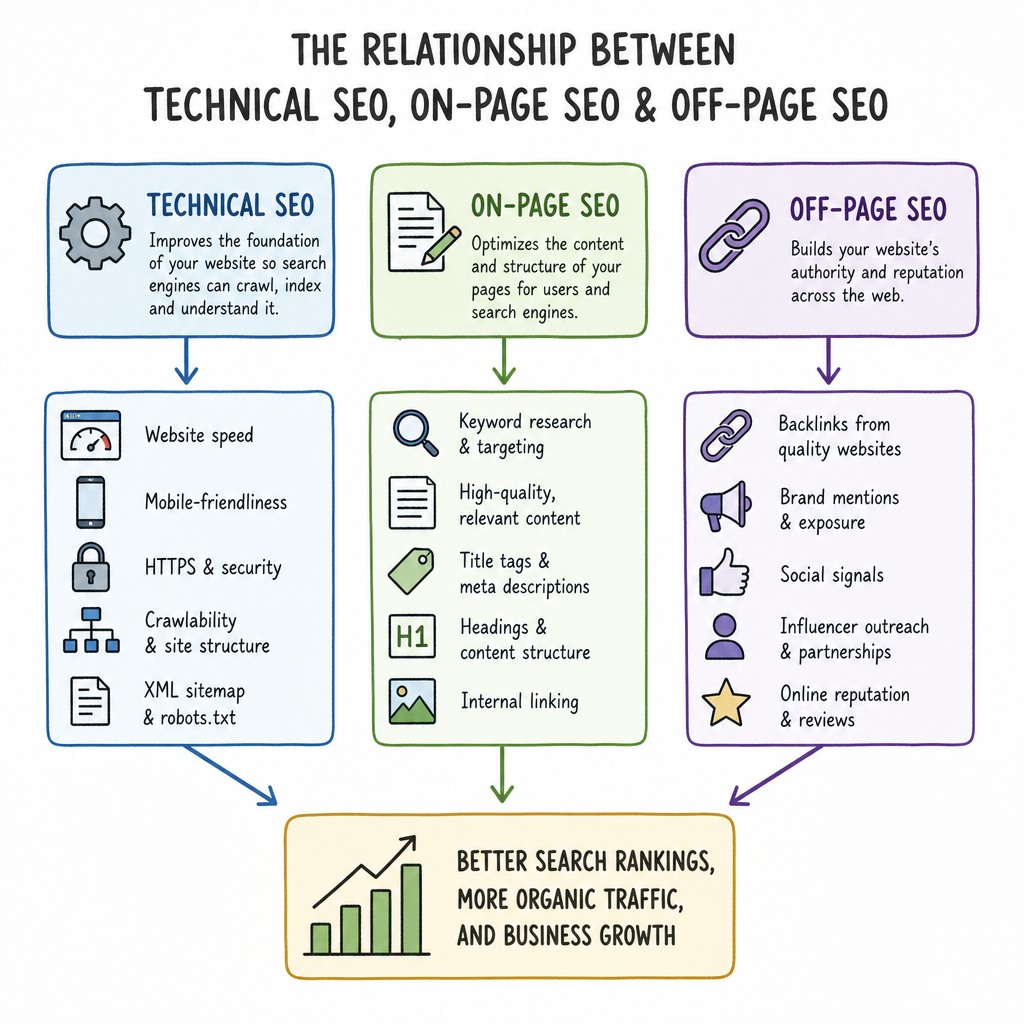
The Foundation: Crawlability and Indexability
Before your website can rank for a keyword, it must be discovered. The discovery process relies entirely on a search engine’s ability to crawl and index your site.
The Traffic Cop: Robots.txt
When a search engine bot arrives at your website, the very first file it looks for is the robots.txt file. Beginners and even some developers often ask: what is the role of robots.txt in website crawling? Simply put, it acts as a digital traffic cop. It provides explicit instructions to search engine bots, telling them which folders and pages they are allowed to crawl, and which ones they must ignore (like private admin dashboards or staging environments).
Overcoming Indexing Hurdles
A bot might be allowed to crawl a page, but technical roadblocks can prevent it from being indexed. Monitoring Google Search Console is non-negotiable for fixing crawl errors and indexing issues. If a bot encounters continuous 404 (Not Found) or 500 (Server) errors, it will eventually stop trying, dropping your pages from search results.
Mastering the Crawl Budget
Search engines do not have infinite resources. They assign a “crawl budget” to your site—the number of URLs they are willing and able to crawl in a given timeframe. Managing crawl budget for large ecommerce sites is incredibly important. If you have 50,000 product variations generated by filters (like color or size), you don’t want Googlebot wasting its daily budget crawling those low-value URLs instead of your money-making category pages.
Actionable Tips:
- Regularly check the “Pages” report in Google Search Console to identify why certain pages aren’t indexed.
- Use the Disallow directive in your robots.txt to block infinite filter loops on e-commerce sites.
Site Structure and Navigation
A well-organized website benefits both human visitors and automated bots.
Optimizing website architecture for search engines means creating a logical, flat hierarchy. As a rule of thumb, any page on your website should be reachable within three to four clicks from the homepage. A flat architecture allows search engine spiders to effortlessly crawl your entire site, ensuring no page is left orphaned and isolated.
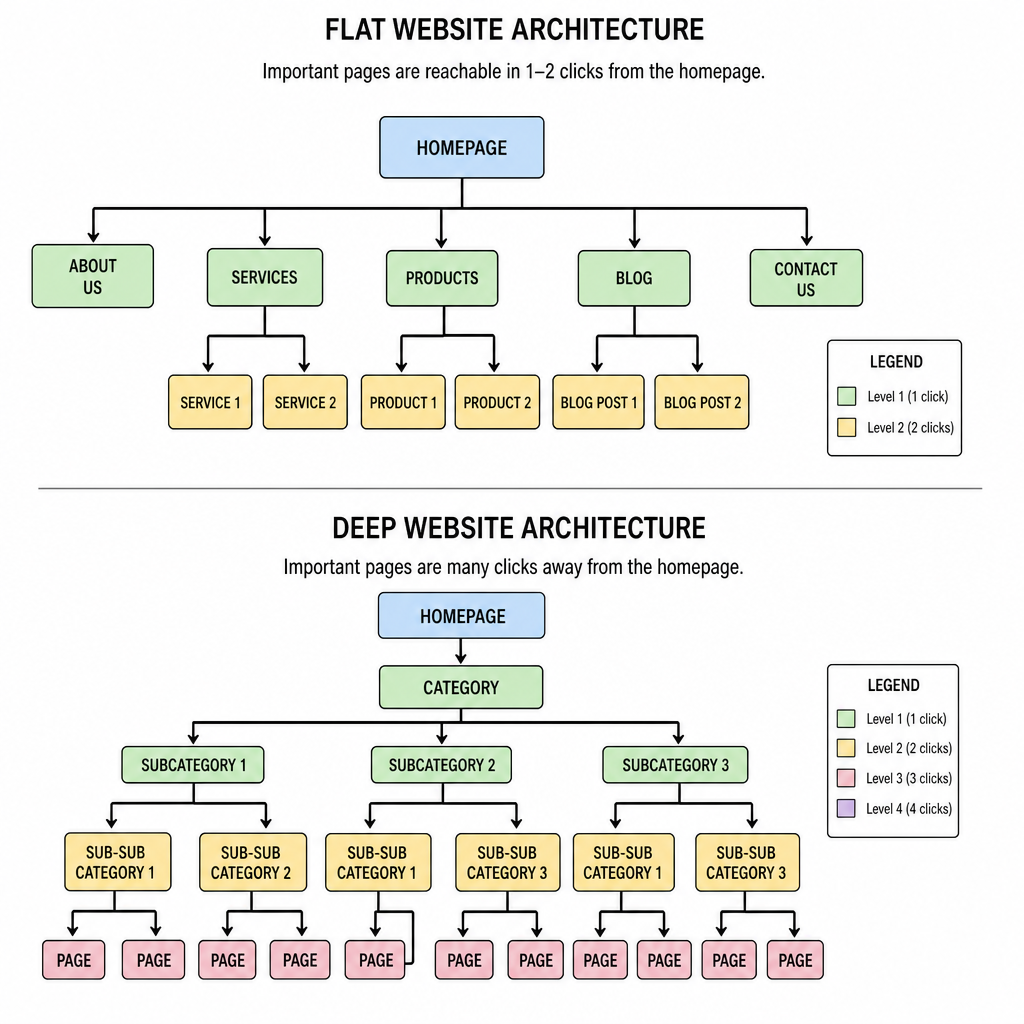
Furthermore, a logical structure enables powerful internal linking strategies for better site hierarchy. By strategically linking your high-authority pages (like your homepage or a viral blog post) to essential product or service pages, you pass along “link equity.” This flow of authority signals to Google which pages you consider most important, helping them rank higher in the search engine results pages (SERPs).
Technical Maps: Sitemaps and Security
Once your architecture is sound, you need to provide search engines with a clear map and a secure environment.
The Power of XML Sitemaps
While robots.txt tells search engines where not to go, XML sitemaps serve as an explicit roadmap of where they should go. These files contain a list of your most important URLs.
Effective XML sitemap optimization for faster indexing involves more than just generating a file. You should ensure your sitemap dynamically updates when new content is published, is free of redirecting or broken URLs (only returning 200 OK statuses), and is broken down into smaller files if you exceed 50,000 URLs.
Securing Your Site
Security is a foundational trust signal. When weighing HTTP vs HTTPS for site security and rankings, the debate is long over. Google has officially confirmed that HTTPS is a ranking signal. Migrating to HTTPS encrypts the data transferred between your server and the user’s browser, protecting sensitive information and preventing browsers from flagging your site as “Not Secure.”
Speed and Performance Optimization
In today’s fast-paced digital landscape, patience is scarce. Site speed optimization is a critical technical SEO priority.
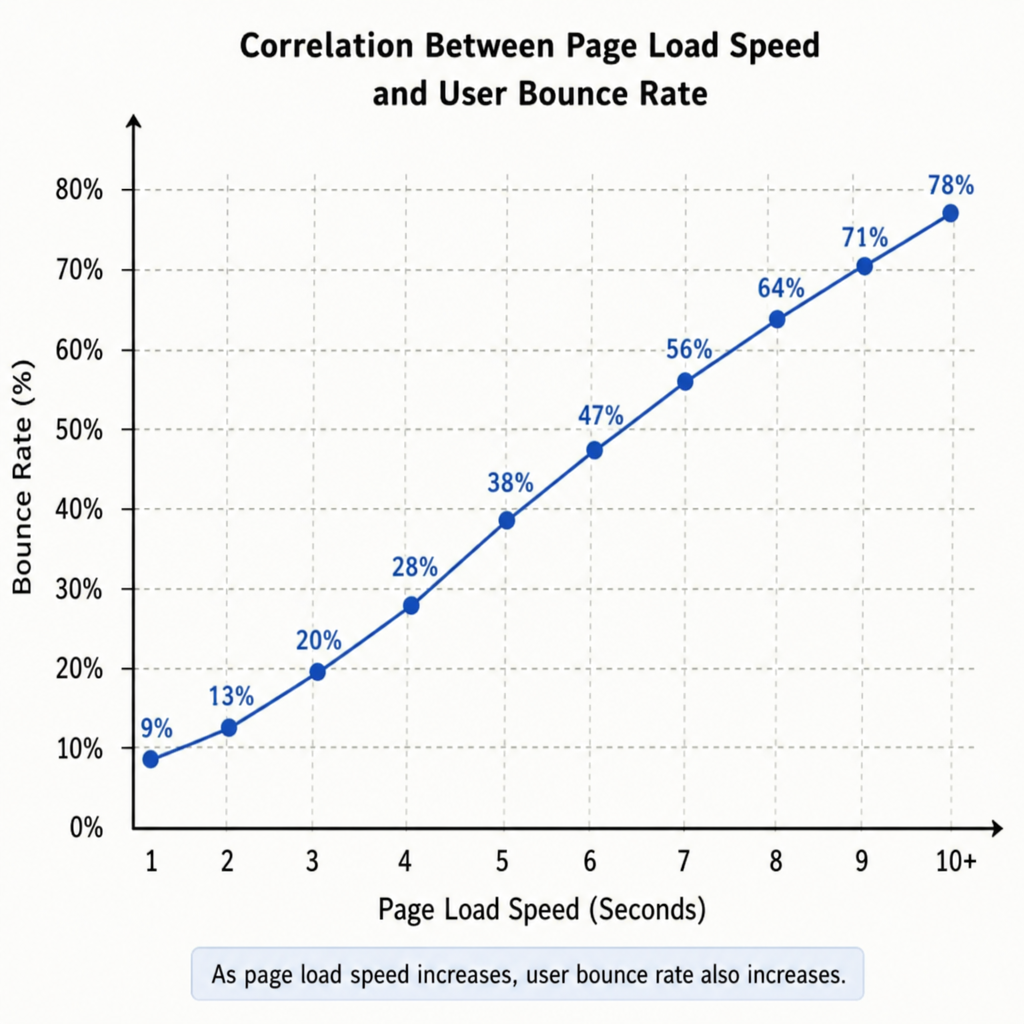
The impact of page load speed on user experience is profound. Studies show that if a page takes longer than three seconds to load, bounce rates skyrocket, and conversion rates plummet. Google understands this, which is why performance directly impacts your rankings.
Core Web Vitals
To measure user experience objectively, Google introduced Core Web Vitals. Consider this your mini Core Web Vitals optimization guide:
- Largest Contentful Paint (LCP): Measures loading performance. Your main content should load within 2.5 seconds. Optimize this by compressing images, utilizing Content Delivery Networks (CDNs), and upgrading your server response time.
- Interaction to Next Paint (INP): Measures visual responsiveness. When a user clicks a button, the site should react immediately. Minimize heavy background scripts to improve this.
- Cumulative Layout Shift (CLS): Measures visual stability. Ensure elements don’t jump around as the page loads by specifying size attributes for images and videos.
The JavaScript Dilemma
Modern websites rely heavily on JavaScript for interactivity, but search engines can struggle to process it efficiently. You must carefully weigh client-side vs server-side rendering for SEO.
Client-side rendering places the burden of loading content on the user’s browser, which can delay Google’s ability to index your text. Server-side rendering (SSR) or dynamic rendering prepares the HTML on the server before sending it to the browser. For SEO purposes, SSR is highly recommended, as it delivers fully formed, easily indexable content immediately to search engine bots.
Mobile Readiness and Content Duplication
The way users access the internet has fundamentally shifted, and search engines have adapted accordingly.
Mobile-First Indexing
Google now predominantly uses the mobile version of a website’s content for indexing and ranking. Adhering to mobile-first indexing best practices means ensuring your mobile site is not a stripped-down version of your desktop site. The primary content, structured data, metadata, and internal links must be identical across both versions. Your site must also utilize responsive design, ensuring buttons are easily clickable and text is readable on small screens.

Managing Duplicate Content
Duplicate content confuses search engines, dilutes your ranking power, and wastes crawl budget. If you have similar content on multiple URLs (e.g., tracking parameters in URLs), you need to master canonical tag implementation best practices. A canonical tag (rel=”canonical”) is a snippet of HTML code that explicitly tells Google which version of a page is the primary, “master” copy that should be indexed.
When a page becomes obsolete or you restructure your site, deleting it outright causes broken links. Instead, focus on resolving duplicate content with redirects. Using permanent 301 redirects seamlessly sends users and search engines to the most relevant, updated page, preserving your hard-earned SEO value.
Advanced Technical SEO Elements
Once the foundation is solid, you can implement advanced tactics to make your search listings stand out.
One of the most powerful tools at your disposal is structured data (also known as schema). Search engines are smart, but they still appreciate explicit context. By implementing schema markup for rich snippets, you translate your content into a specialized vocabulary (JSON-LD) that search engines easily digest.
For example, if you run a recipe blog, schema markup tells Google the exact cooking time, calorie count, and user rating. Google can then display this information directly in the search results as an eye-catching “rich snippet.” Rich snippets dramatically increase your click-through rates (CTR) by making your listing more visually appealing than standard blue links.
Auditing and Maintenance
Technical SEO is not a “set it and forget it” task. Websites are living ecosystems that constantly change as new content is added, plugins are updated, and code is altered.
If you want to know how to perform a comprehensive technical SEO audit, the process requires specialized tools like Screaming Frog SEO Spider, Ahrefs, or Semrush.
- Step 1: Run a full site crawl to identify broken links (404s) and redirect chains.
- Step 2: Analyze your Google Search Console coverage report for indexing warnings.
- Step 3: Test your page speed using Google PageSpeed Insights and implement fixes for failing Core Web Vitals.
- Step 4: Review your robots.txt, XML sitemaps, and canonical tags for accuracy.
By following these technical SEO tips, you can systematically diagnose and cure the technical ailments holding your website back.
Conclusion
Technical SEO can seem intimidating due to its complexity and reliance on code, but it is entirely manageable when broken down into its core components. By adhering to general SEO best practices—from securing your site and optimizing for speed, to guiding search engine bots effectively—you build an unbreakable foundation for your digital presence.
Remember, creating great content is only half the battle. Mastering these technical SEO elements is the key to ensuring that your target audience can actually find, experience, and benefit from what you have to offer. Keep auditing, keep optimizing, and watch your organic traffic thrive.
Read more on Understanding Site Architecture for SEO