

The digital landscape is more crowded than ever, making the battle for organic visibility a top priority for businesses and creators alike. At the heart of this battle is seo content creation. Gone are the days when you could simply stuff a page with keywords and watch it climb to the top of Google. Today, modern algorithms are incredibly sophisticated, demanding content that provides genuine value, context, and a flawless user experience.
If you are wondering how to write for search engines and users simultaneously, you are in the right place. Bridging the gap between algorithmic requirements and human engagement is an art form. Whether you are launching a brand-new website or looking to scale an existing platform, mastering this dual approach is what separates high-traffic websites from digital ghost towns.

Understanding the Foundation of Modern SEO Content
Before you draft a single sentence, it is crucial to understand the foundational principles of search engine optimization content writing. Writing for the web requires a distinct mindset that differs significantly from print or purely creative writing.
SEO Copywriting vs Traditional Copywriting
To succeed in the digital space, you must understand the difference between seo copywriting vs traditional copywriting. Traditional copywriting focuses primarily on persuasion, branding, and driving an immediate emotional response or sale. While SEO copywriting also aims to convert, it has a crucial secondary audience: search engine crawlers. SEO web writing is about structuring that persuasive, engaging text in a way that algorithms can easily parse, categorize, and rank. It involves integrating targeted phrases naturally while maintaining an authoritative and engaging voice.
Cracking the Code: Search Intent Optimization
The most important ranking factor today is satisfying the user’s query. This is where search intent optimization comes into play. If your content does not deliver exactly what the user is looking for, search engines will quickly bury it.
Generally, search intent falls into four categories:
- Informational: The user wants to learn something (e.g., “how to fix a leaky faucet”).
- Navigational: The user is looking for a specific website (e.g., “Twitter login”).
- Commercial Investigation: The user is comparing products before buying (e.g., “best CRM software 2024”).
- Transactional: The user is ready to purchase (e.g., “buy Nike running shoes size 10”).
Before drafting any seo blog posts, analyze the current top-ranking pages for your target query. If the top ten results are all ultimate guides, your short opinion piece won’t rank. You must match the intent of the keyword perfectly.
Developing a Robust Content Strategy
Great seo content writing is not spontaneous; it is the result of meticulous planning and strategy.
Keyword Mapping for Content Strategy
Randomly targeting keywords across your website leads to keyword cannibalization, where your own pages compete against each other in the search results. To prevent this, utilize keyword mapping for content strategy. This process involves assigning specific primary and secondary keywords to distinct pages on your website. By mapping out your content, you ensure that every page serves a unique purpose, guiding users logically through your marketing funnel without confusing search engine crawlers.
The Topic Clusters and Pillar Page Model
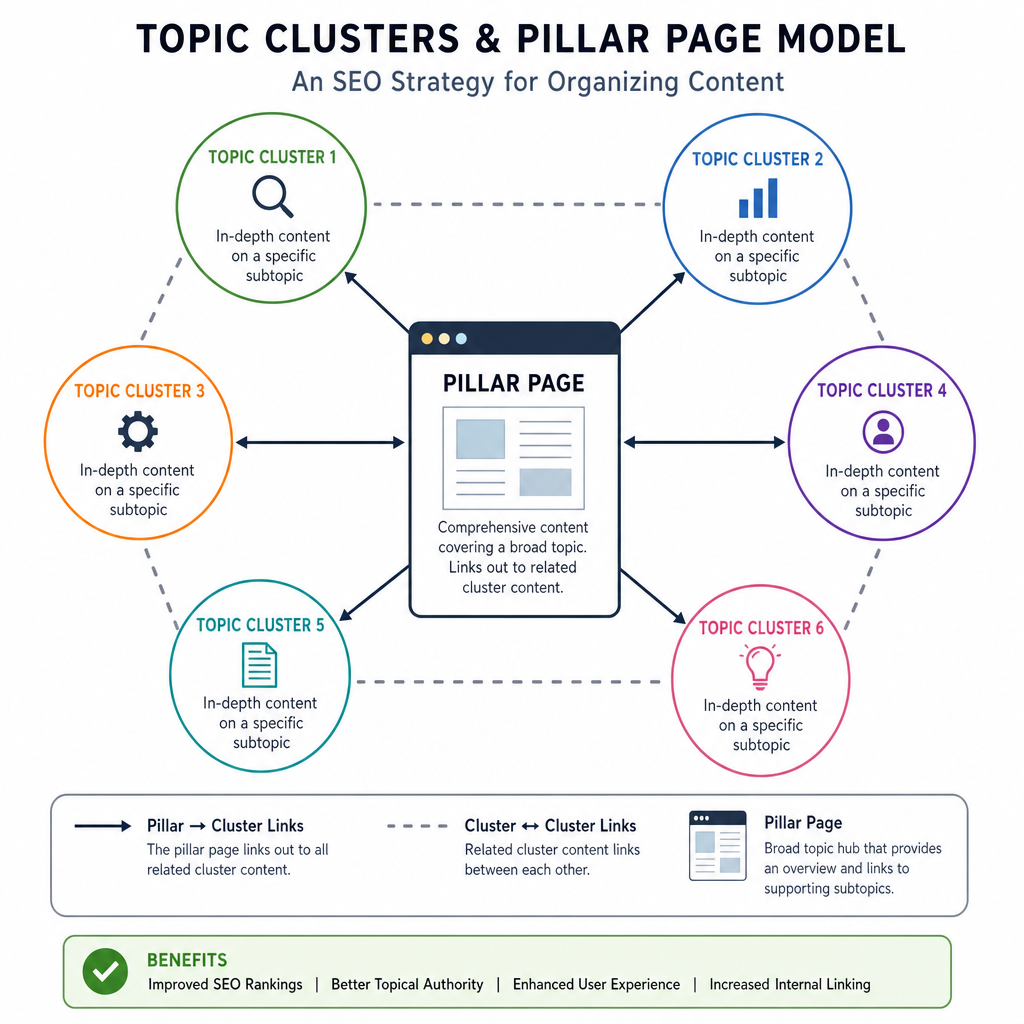
One of the most effective ways to establish topical authority is by adopting the topic clusters and pillar page model. Instead of writing isolated articles, create a comprehensive “pillar” page that covers a broad subject at a high level. Then, write several detailed “cluster” pages that dive deep into specific subtopics.
For example, your pillar page might be “The Ultimate Guide to Digital Marketing,” while your cluster pages cover “Social Media Strategies,” “Email Marketing Automation,” and “PPC Advertising.” By interlinking these cluster pages back to the main pillar page, you signal to search engines that you are a comprehensive, authoritative resource on the overall subject.
Long-Form Content vs Short-Form Content
A frequent debate among marketers is long-form content vs short-form content. The truth is, the ideal length depends entirely on the search intent. If a user asks, “What is the capital of France?” a short-form, concise answer is best. However, for complex topics like “how to build a website from scratch,” long-form content naturally performs better because it allows for depth, comprehensive coverage, and more opportunities to include latent semantic keywords. Do not pad your word count with fluff; aim to be comprehensive but concise.
Advanced Writing and Optimization Techniques
Once your strategy is in place, the execution of your seo content creation must be flawless. Incorporating modern technological considerations into your writing will give you a significant competitive edge.
Semantic SEO Strategy and Natural Language Processing
Search engines no longer look at keywords in isolation; they analyze the relationships between words. Implementing a semantic seo strategy means covering a topic so thoroughly that you naturally include related concepts, synonyms, and subtopics.
This ties directly into natural language processing in content optimization. Google uses NLP algorithms to understand context, entity relationships, and sentiment. To optimize for NLP, write clear, direct sentences. Define complex terms immediately, use active voice, and structure your paragraphs so that entities (people, places, concepts) are clearly linked to their attributes.
Incorporating E-E-A-T into Blog Posts
Google heavily weighs Experience, Expertise, Authoritativeness, and Trustworthiness (E-E-A-T) when ranking content. Incorporating E-E-A-T into blog posts is non-negotiable, particularly in YMYL (Your Money or Your Life) niches like health or finance.
- Experience: Share first-hand, real-world experience with the topic or product.
- Expertise: Highlight the author’s credentials via detailed author bios.
- Authoritativeness: Earn backlinks from reputable sites in your industry.
- Trustworthiness: Cite verifiable sources, ensure your site is secure (HTTPS), and be transparent about affiliate links.
Whether you run a hyper-local business site or an international suchmaschinenoptimierung blog (SEO blog), proving to users and search engines that your content is credible will dramatically boost your rankings.
Meta Tags and Header Hierarchy Best Practices
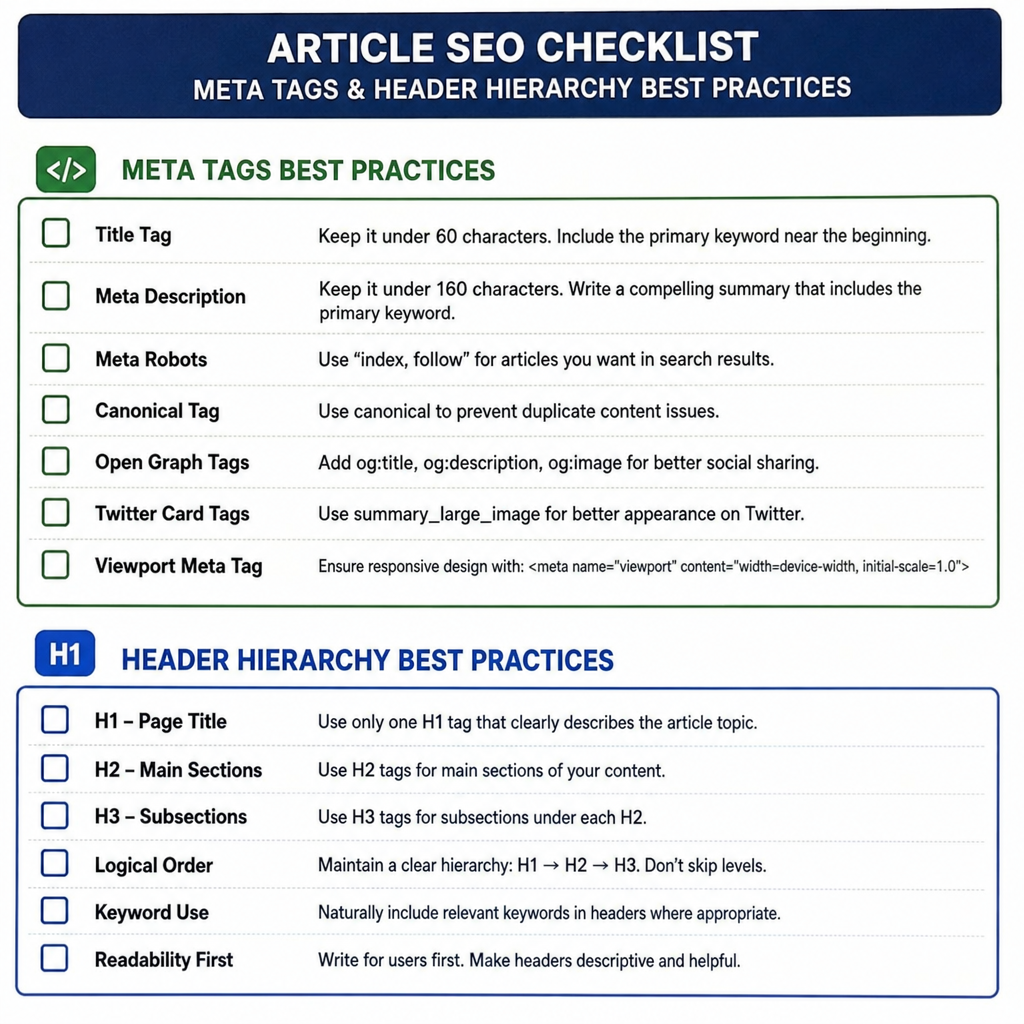
Structure is the skeleton of your article. Adhering to meta tags and header hierarchy best practices ensures crawlers can index your page correctly.
- Title Tag: Keep it under 60 characters, compelling, and front-loaded with your primary keyword.
- Meta Description: Write a persuasive 150-160 character summary that encourages click-throughs.
- Headers (H1, H2, H3): Use only one H1 tag per page (the title). Use H2s for main sections and H3s for subsections. Never use headers just to make text larger; use them to create a logical, hierarchical outline of your topic.
Improving Content Readability for Rankings
A wall of text will cause users to bounce back to the search results immediately, signaling to Google that your page offers a poor user experience. Improving content readability for rankings is highly effective.
- Keep paragraphs short (3-4 sentences maximum).
- Use bullet points and numbered lists to break up information.
- Highlight key takeaways in bold.
- Write at an 8th-grade reading level to remain accessible to a broader audience, unless your specific niche requires highly technical jargon.
Optimizing for Featured Snippets
Securing “Position Zero” can skyrocket your organic traffic. Optimizing for featured snippets involves formatting your content so Google can easily extract a direct answer. If you are targeting a “What is…” question, provide a clear, concise definition of 40 to 60 words immediately following a related H2 or H3. For “How to” queries, utilize numbered lists that walk the reader through the process step-by-step.
Post-Publishing: Auditing and Analyzing
One of the most vital seo tips to remember is that publishing is not the finish line. SEO is an ongoing, iterative process. Your content strategy requires routine maintenance to sustain organic growth.
Measuring Content Performance with Search Console
To truly understand how search engines view your website, you must get comfortable with data. Measuring content performance with search console (Google Search Console) allows you to see exactly which queries are driving traffic to your pages. Pay close attention to your click-through rates (CTR) and average positions. If you find a page ranking on the second page of Google for a high-volume keyword, that page is a prime candidate for an update and a slight optimization push to get it onto page one.
Content Audit for Organic Traffic
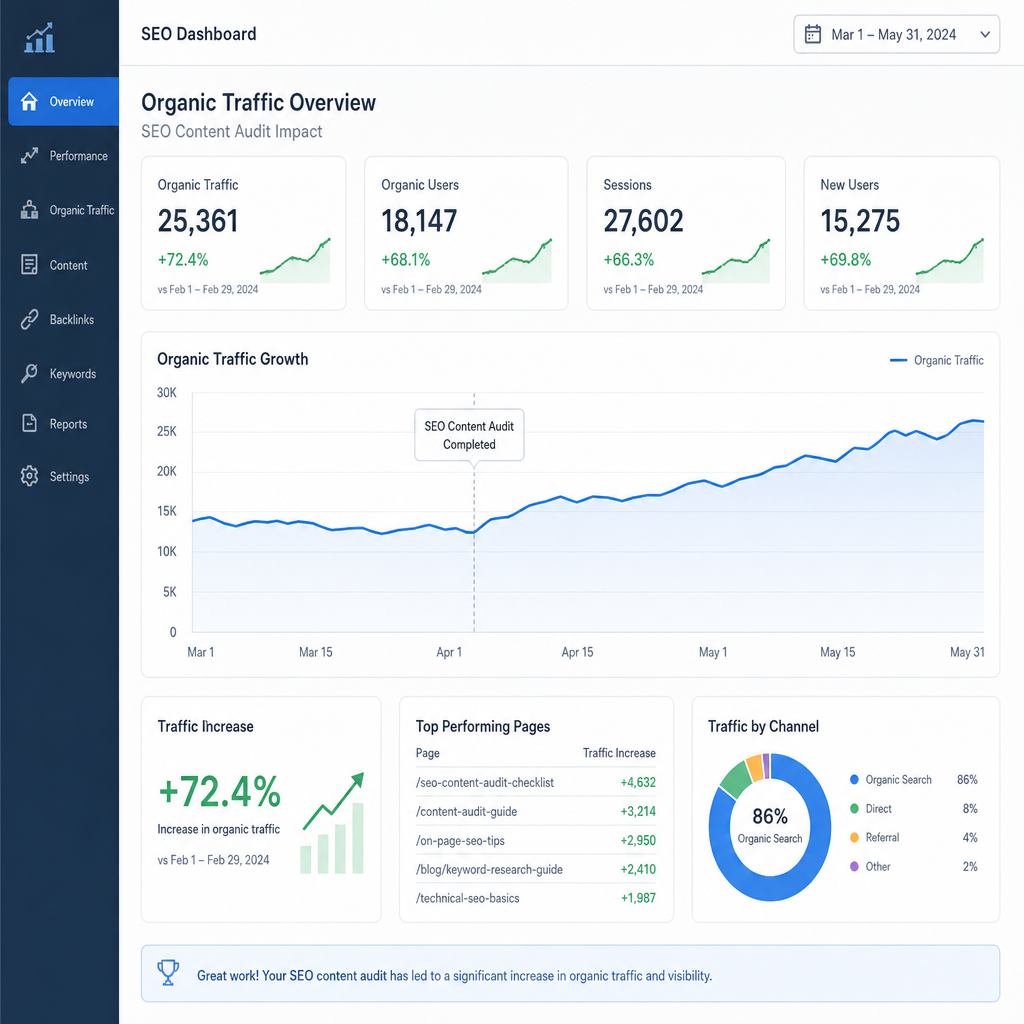
As your website grows, some content will inevitably become outdated or underperform. Conducting a regular content audit for organic traffic is essential for site health. Export your page data from Google Analytics and Search Console, and categorize your existing content into three buckets:
- Keep: High-performing content that generates consistent traffic.
- Update: Content that is ranking but slowly losing traffic, or pages that are sitting on page two or three of the search results.
- Delete/Redirect: Outdated, thin, or duplicate content that offers no value. Redirect these URLs to more relevant, high-quality pages.
Repurposing Existing Articles for Better SEO
Instead of constantly reinventing the wheel, look closely at your “Update” bucket. Repurposing existing articles for better seo is a highly efficient way to scale your traffic. This might involve expanding a thin 500-word article into a comprehensive 2000-word definitive guide. You can refresh outdated statistics, add new multimedia elements, address new search intent queries, and improve the internal linking structure. Search engines love fresh content, and updating an existing URL often yields faster ranking improvements than publishing a brand-new post.
Conclusion
Mastering the art of seo content creation requires a delicate balance of technical precision and human empathy. It is about understanding the algorithms that organize the world’s information while deeply respecting the humans who are searching for it.
By implementing search intent optimization, structuring your website with the pillar page model, and utilizing advanced techniques like natural language processing and E-E-A-T, you set yourself up for sustainable, long-term success. Remember that digital landscapes are always evolving. Continually monitor your data, refine your strategies, and never lose sight of your primary goal: creating exceptional content that truly serves the reader. Apply these essential tips, and watch your organic visibility soar.
For more information on SEO for small businesses